

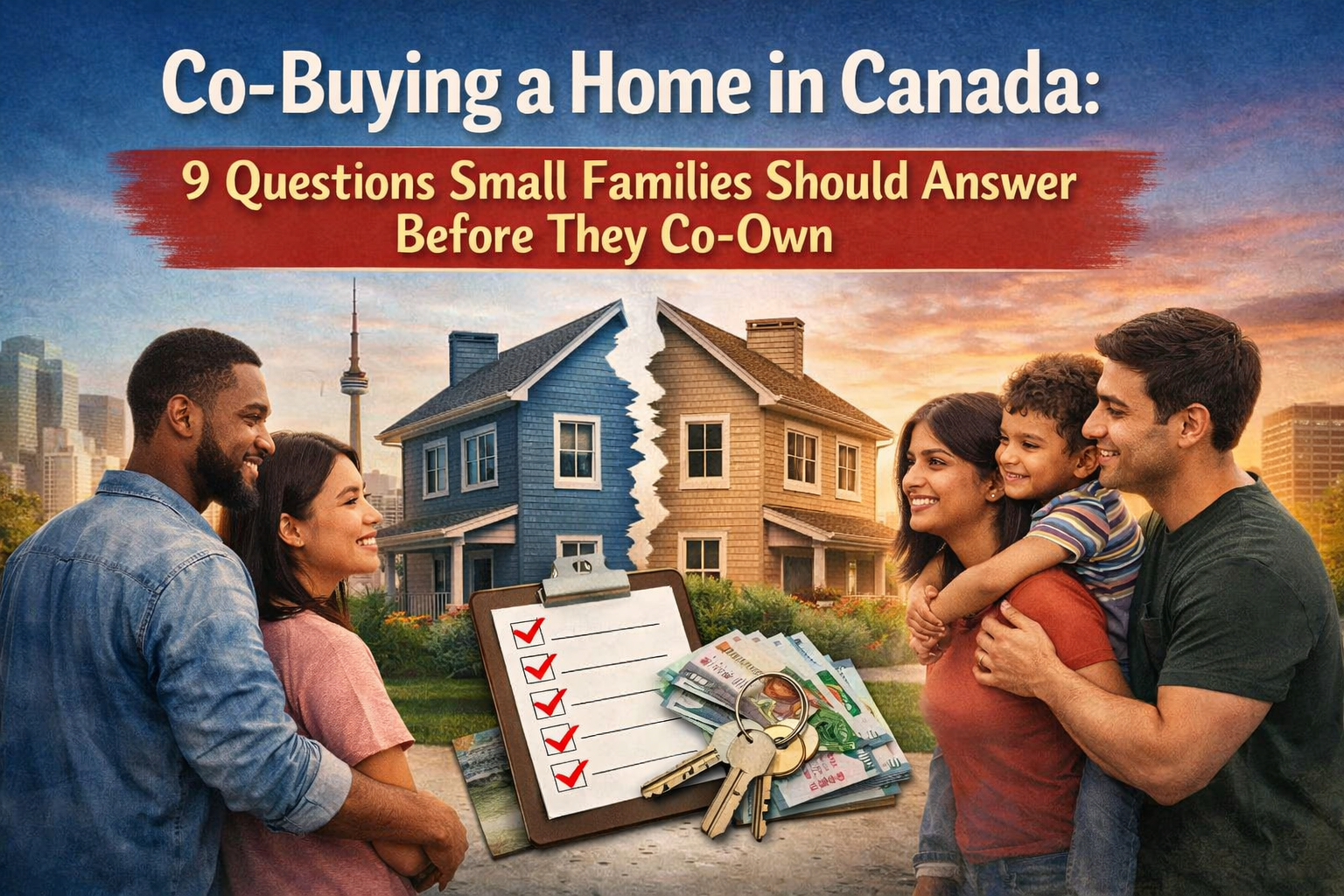
Co-buying (co-ownership) is showing up more and more in Canadian housing conversations—especially for small families who want stability but can’t (or don’t want to) do it alone.
But here’s the truth: co-ownership doesn’t succeed because the home is perfect. It succeeds because the plan is clear.
If you’re considering co-buying a home in Canada with another family, a sibling, or a trusted partner, these 9 questions will help you avoid the most common stress points—and make smarter decisions before money gets involved.
If you want a simple overview of the full process and support options, start here:
https://jointpropertymatch.com/how-it-works/
1) Are we co-owning to solve a short-term problem—or to build long-term stability?
This matters because it affects what you buy, where you buy, and how you set up your exit plan.
Examples
Short-term (1–3 years)
“We need stable housing while kids are young / until income increases.”
Long-term (5+ years)
“We want to build equity together and stay put.”
If your timelines don’t match, co-ownership gets messy fast.
2) What’s our maximum monthly payment (not just the purchase price)?
Families often focus on the listing price and forget the true monthly cost.
Your real monthly housing budget should include:
- Mortgage payment
- Property taxes
- Utilities
- Insurance
- Maintenance / repairs
- A buffer for surprises
A credible mortgage basics resource (helpful for first-time co-buyers):
https://www.canada.ca/en/financial-consumer-agency/services/mortgages.html
3) Are we aiming for separate living spaces—or shared living?
For small families, privacy is a quality-of-life issue.
Simplest setups (when possible):
- Basement suite / in-law suite
- Separate entrances
- Duplex-style layouts
If you’ll share a kitchen and living room, you’ll need clearer rules and boundaries—and ideally those rules in writing.
4) How are we splitting the down payment—and what does that mean for equity?
Down payments are often uneven. That’s fine—as long as everyone agrees how equity will be calculated.
Common scenarios
- 50/50 down payment, 50/50 monthly costs
- 60/40 down payment, 50/50 monthly costs
- 60/40 down payment, 60/40 equity and costs
The key: your ownership structure must match the financial reality.
5) How do we handle kid-related lifestyle differences?
This is the “quiet problem” that becomes the loud problem.
Talk about:
- Bedtime routines and noise expectations
- Screen time / shared space use
- Cleaning standards
- Guests and family visits
- Pets (now or in the future)
If you can’t talk about these now, co-owning will force the conversation later—at the worst possible time.
6) Who decides what—and how?
Decision-making is where co-ownership relationships either mature or crack.
Agree on:
- Which decisions require unanimous agreement
(selling, major renovations, refinancing) - Which decisions can be majority-based
(minor repairs, small purchases) - Spending thresholds
(example: anything over $500 requires both approvals)
This should be written into your co-ownership agreement.
7) What happens if someone can’t pay for 2–3 months?
If you plan for this, it’s solvable.
If you don’t, it becomes emotional and expensive.
A strong plan includes:
- An emergency fund strategy
- Clear timelines for late payments
- What happens next (repayment plan, temporary cost shifts, or sale trigger)
8) What’s the exit plan if one family wants out?
Life changes. Jobs change. Families grow.
Plans shift.
Your agreement should clearly define:
- Buyout options
(how the home is valued, timelines, financing expectations) - The process for selling
(who lists it, how decisions are made) - Dispute resolution
(mediation if co-owners disagree)
If you want help building a safer shared ownership plan, start here:
https://jointpropertymatch.com/contact-shared-ownership-experts/
9) Who are we co-owning with—and how do we reduce risk upfront?
Even when everyone’s a good person, compatibility matters.
Co-ownership works best when co-owners align on:
- Money habits
- Communication style
- Cleanliness and boundaries
- Long-term goals (stability vs investment vs flexibility)
This is why matching and screening support can be valuable—because “nice” isn’t the same as “compatible.”
Learn more about how Joint Property Match supports the matching process:
https://jointpropertymatch.com/how-it-works/
Quick Checklist: Co-Ownership Readiness (For Small Families)
Before you co-buy, aim for “yes” on these:
- We agree on monthly budget and timeline
- We agree on living setup (shared vs separate)
- We’ve discussed kid-related routines and boundaries
- We’ve agreed on decision-making rules
- We have an emergency plan
- We have an exit plan
- We’re willing to put everything in writing
Next step: Find Your Match with the KeyCoMatch App
Finding the right co-ownership partner is one of the most important parts of shared homeownership. KeyCoMatch helps Canadians connect with compatible co-ownership partners based on budget, living preferences, and timeline.
The platform also includes a vetting process to help reduce risk and improve match compatibility, making it easier to move forward with confidence.
The app can also be used by property owners or individuals looking to rent to compatible households.
Download the KeyCoMatch app for free:
Apple App Storehttps://apps.apple.com/us/app/keycomatch/id6749037983
Google Play Store
https://play.google.com/store/apps/details?id=com.keycomatch.app&pcampaignid=web_share